We left our hearts in San Francisco.
We had a plan: “France 2020,” we called it. The dream was that we would move to France in 2020. We did not. Instead, there was a global pandemic that shut down business as usual, including travel. We lived in San Francisco with the understanding that we didn’t know how long we’d be there, but we’d make it home nevertheless. Suddenly, days turned into weeks, which in turn turned into years.
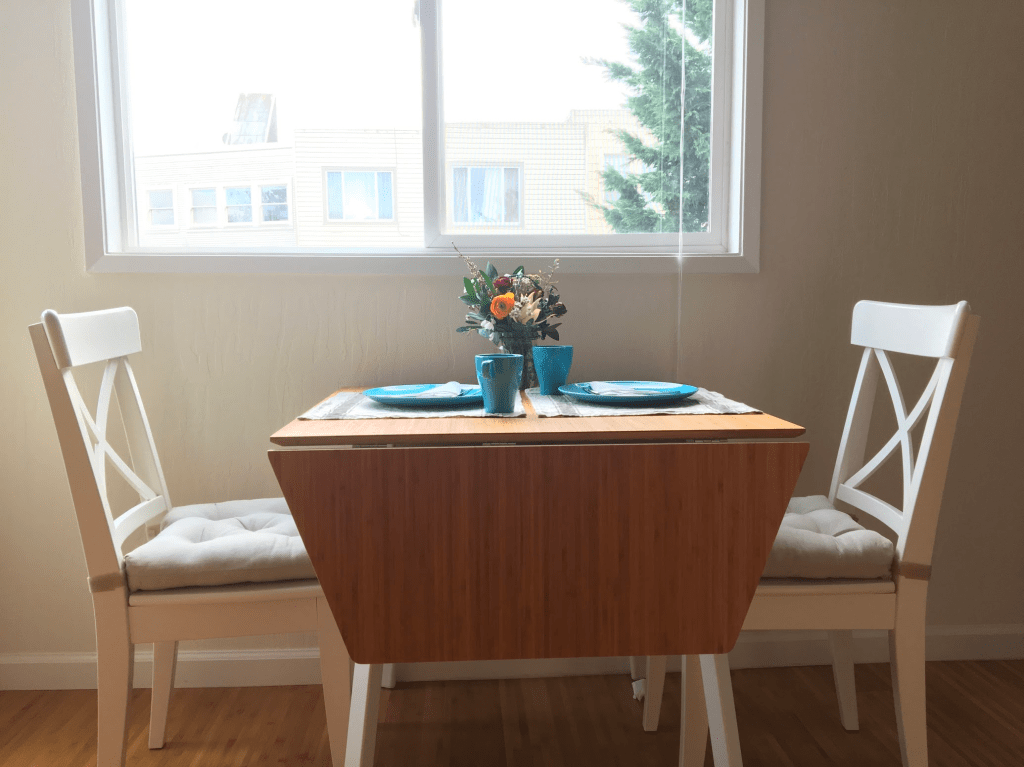
Nestled in Noe Valley, we procured Scotch tape and Command strips. We dusted off photos that we had kept in boxes and decided to hang them up. We invited the faces of family and friends we missed to beam upon us from the walls, allowing them to see the light of day at last.
When we met our neighbors and spoke on the street, we exchanged mundane but weirdly intimate observations: “You’re the ones with the cat.” “You’re the ones with the festive lights and music.” “You’re the ones who sweep a lot.” “The woman who lived there passed away. You won’t be seeing her any more.” “You got married this morning, I saw you leaving.”
We befriended our neighbors and had cooking exchanges and happy hours and pet birthday parties and people birthday parties and block parties. Things got serious when our neighbors gave us a drill: We drilled holes into the drywall and anchored a bookshelf and a TV in place.

Wrapped in thick, fleece blankets, we devoured books like “Born a Crime” and “Crying in H Mart” and “Braiding Sweetgrass” and “Black is the Body.” We devoured silly and serious TV series like “The Crown” and “Kim’s Convenience” and “Never Have I Ever” and “Borgen” and “Schitt’s Creek” and “Drive to Survive” and “This is a Robbery” and “Never Too Small” and wondered where the time went.
We burned through multiple candles lit with a flame that mimicked the flicker of a fireplace. Some had names like “Homesick: New Jersey” and “Homesick: Wyoming,” though none actually smelled like the places where we grew up.

We upgraded our “work-from-home” stations — one desk squished beside the refrigerator, the other in what we called “the studio.” We added comfy chairs and plants, some greener than others, and got down to business, mentoring and playing games and making films and stories with friends over video calls. We smoothed removable wallpaper on the walls.
Daily seeking fresh air, we explored the infinite routes at the parks around us — Douglass and Holly and Billy Goat and Precita and Dolores and Upper Noe Rec.
We asked our neighbors to help take care of our cat when we were out; they dutifully fed and played with her. We responded to our neighbor’s phone call for help when there was a spider on the premises; I dutifully trapped and released it.
* * *

On weekends, we left our San Francisco neighborhood. Sometimes we’d leave for errands, sometimes for adventure. We went on dates to the movie theater in Daly City, “the Gateway to the Peninsula.” We found peace in walks by the ocean in Pacifica, its vast blue opening like an infinite gift as we cruised over the hill.
One weekend, we traveled to Tahoe to meet our friends visiting from out of town. Driving in the dark on winding roads, smelling the crisp, clean air before snowfall, seeing our friends carry their new baby down the mountain, and feeling the soft pine needles and dirt padding our path stirred my spirit.

During our trip, rain poured. We returned to San Francisco as the roads flooded behind us. Upon our arrival, our apartment, homey and hospitable as it was on the interior, was less so on the exterior. The metal plates that protected the locks of the front door were unscrewed, the frame splintered by a crowbar.
Oddly, it wasn’t the attempted intrusion that made me realize I wanted to move. It was the absence of smell. Unlike Tahoe, there was no rich dirt or pine. Everything was strictly paved.
Suddenly, our perfectly pleasant, perfectly almost perfect neighborhood felt sterile, life absent.
I missed the plains, mountains, and lakes of my childhood. I went back to where I thought home was. I spent weeks revisiting the places of my past, the places I’d called home longest, along the Front Range. Under the sky’s thick blanket of stars, I could see myself laying down in a field and becoming flowers, one with the earth.

This comes to mind from Emily Bernard’s essay, “Going Home”: (My grandmother) took me to visit family landmarks reluctantly, uneasy about my desire to take photographs and explore on foot. ‘You get to leave, but I have to live here,” she would remind me.”
Upon my return to Colorado, someone asked me where I was from. I felt mistaken, foreign. “Here!” I wanted to be able to say. The answer was and wasn’t true.
I had left; returning was not the answer while we were so restless.
So where was home?
* * *
I received a message from a high school friend. She had moved to Berkeley, and would I like to meet up?
J and I made our way from San Francisco over the Bay Bridge. We stopped on a quiet street facing a park. We realized we’d been there before.
In Berkeley, J and I spent the morning enjoying the company of old and new friends, and the afternoon exploring pockets new and old, independently and together. We loved it so well that we decided to return the next day, and the week after.
It happened to be Halloween. Out of curiosity, we looked to see what homes were available in the area. There was one: a townhouse that clocked in at 1,299 square-feet in the online description, but 720-square feet in the city records, the reason for the discrepancy unknown.
A map under the Home Owners’ Loan Corporation, instituted under President Franklin Roosevelt in 1933, labeled the area as “hazardous”—redlined. Once in official government documents for surrounding neighborhoods was this requirement: “Whites-only.”
“Berkeley considers itself a progressive city. It was one of the first places to declare itself a nuclear-free zone, to recognize same-sex relationships, to actively desegregate its schools and to ban Styrofoam,” Jesse Barber wrote in the Berkeleyside newspaper, “But the history of Berkeley, like most cities across the U.S., includes using discriminatory practices to segregate the races. Those decisions, made decades ago, are still playing out today.”
Outside the property, a woman dressed in a sunflower costume waved at us. Her arm looked like a leaf swaying in the sun, her smile broad as the sunflower she was dressed as. Later, we would learn that V was of Taíno descent and a lineage of incredible strength and resilience. Later, we would learn she was on her way to take her son to a Halloween party, their costumes inspired by the video game series Plants Vs. Zombies. “Open house?” V said, waving her leaf-clad arm. “It’s right through here, on the right.”
We went through a front door under a grand, old tree. It smelled fresh — like cedar, like earth. We entered a room where light poured in. We immediately felt it: We were home.
It was time to move.
* * *
Nostalgia and sentimentality are all powerful, rose-tinted glasses. Presented with the idea of leaving San Francisco, the things that I disliked about the city suddenly paled—the break-ins, the housing and mental health crises, the theft, the violence, the poop. The things I loved magnified.
On a Friday night in November, our neighbor threw a party for her graduation and birthday.
For the first time since the pandemic, we went to a party. We gathered at The Lucky Horseshoe, which we’d heard had been sold to a longtime customer who’d won the lottery. We met new people, laughed with them, sang with them. It was karaoke night after all. When the power cut to a blackout, people pulled out their cell phone flashlights and kept playing pool, single-gloved hands and masked faces and green felt tables softly illuminated as the balls clicked, clacked, and snapped against each other.
On the way home, we headed to the Golden Gate Pizzeria that had replaced the Pizza Hut. J ordered an extra-large Fisherman’s Wharf, topped with shrimp, clams, corn and garlicky white sauce. We ate slices on the street as we walked.
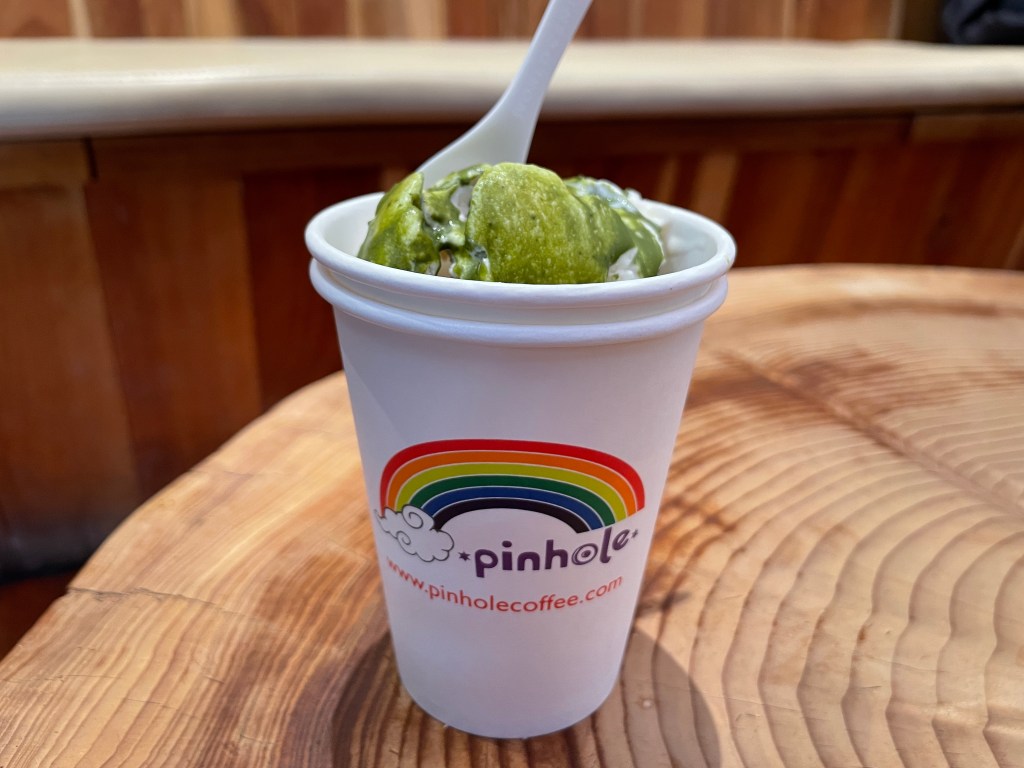
We passed Wild Side West (a bar that’s really an enchanted garden), Pinhole Coffee (a spot to sit in beauty and quiet conversation), and Thilak (where we’d take visitors for exquisite curry and garlic naan).
On Mission Street, Taqueria Cancun, where we split shrimp burritos, was winding down. In full swing was the Royal Cuckoo, where I’d sipped an old-fashioned, tuned into the Hammon organ, and made unfulfilled plans right before the pandemic to build theater sets with the magician from The Magic Patio down the block. The crowd spilled out to tables on the sidewalk. A new building rose where a fire had destroyed its predecessor. At El Rio, the artworks of James Dean smoldered and Carmen Miranda smiled.
Closed for the night was CafeSeventy8, where we wrote dozens of cards and letters and sent them to loved ones around the world from the post office on Tiffany Street. During the pandemic, the cafe team remodeled. “There was a time when we weren’t doing too much else,” the barista explained.
Closed was Cellar Makers, with its toasty and caramelized, square-shaped pizzas and bubbles of burrata.
Closed was Alexander’s Shoe Repair, which had fixed up the kitten heels I’d been given by my high school friend and wore for J’s and my civil union, the red patent leather complimenting the blue of his suit.
Closed was Los Panchos, where the family makes platters of hot pupusas with loroco and beans and tangy cabbage.
Closed was Outer Orbit, where we invited a hodgepodge of friends for a birthday party and played hours of pinball over vegan SPAM musubi and Togarashi tots, encouraged by bartender Ruby.
Closed for the night was Big Lots, where I’d bought a curtain rod and toilet paper, and where the cashier said, “Honey, you’ll be coming here a lot,” after we moved to the neighborhood some years ago.
We passed The Rock Bar (“Where good sports come to watch great sports”), and the corner laundromat on 29th Street where my practical coworker and her spouse had exchanged vows of marriage, and the other laundromat a couple blocks away where J and I had exchanged bills for quarters.
Closed were Safeway and Walgreens, this one spared from the permanent shutdowns that were planned due to retail theft.
Mitchell’s Ice Cream, where we had decided to make a go of it in the neighborhood over a grasshopper pie sundae five years earlier, was closed until the morning.
Closed was Cafe XO, where a decade earlier I’d conducted an interview with an artist that led to a short documentary she said was the favorite telling of her story; she’s since moved away from San Francisco to a more affordable city in Idaho.
Closed were the corner shops Church Street Produce and Chuck’s Sun Valley Market where we could reliably get anything from a bag of chips to an onion to drain cleaner.
We passed Henry’s Hunan (which satisfied my craving for sweet and sour pork) and Regent Thai (serving up golden pouches that are hot to the touch) and Inle (which starred noodle soups for special nights when we wanted to stay close to home).
Closed was the cannabis shop I lined up for when it first opened, mistakenly thinking it was the grand opening for a bath and body shop. I still haven’t been inside, but I have continued to exchange greetings with the person checking IDs at the door. “It’s good to see you again,” he said last week.
Gone was Copy Central, a Latina-owned space of community organizing and printing. It stood empty.
Gone was Angkor Borei, one of the only Cambodian restaurants in the Bay Area. It stood empty.
Gone was Virgil’s Sea Room, opened by a Hard French DJ and Harvey Milk Club president. It became a bar called Mothership.
Gone was Iron and Gold, where J and I had won a black and white photo of what was perhaps original, bearded 49ers — the Gold Rush miners, not the football team — and received a gift at last call on the night the bar closed for good. It was a bottle of bitters infused with five-spice, a key ingredient to one of the most delicious cocktails we’ve had: the dubiously dubbed “Opium Den,” my feelings about the name as mixed as the drink.
J and I strolled up to our apartment building, painted a chilling gray and brash lime green. “Your hallway is spooky!!” a friend had described the entrance; it was especially so when we flanked its sides with glowing jack-o-lanterns named Gorgonzola and Lenny that we’d carved at a pre-Halloween pumpkin party. By November, Gorgonzola and Lenny were molding, their mouths spilling black fuzz.
We waved at the neighbors as they parallel parked on the street after their own evening out.
“I think this is the most fun night we’ved in years, and all of Covid,” J said.
“I agree,” I answered. Gently, I asked, “Are you still ready to go?”
My eyes turned skyward. The full, midnight moon was haloed by an amethyst and emerald moonbow, and was surrounded by constellations I swear hadn’t burned so bright before. I thought of my friend Mariana, who’d taught me to also see the Three Wise Men where I once only saw Orion’s Belt, three pin-prick stars out of billions.
J’s response was emphatic. “Yes,” he said. “Are you?”
“Yes,” I said. “I’m ready.”
* * *
Since that night, San Francisco has been exceptionally beautiful. The skies are the brightest blue, the bougainvillea riotously fuschia.

We had breakfast at Toast, the first and only place where the waitress could say, “The usual?” and we need only say, “Please,” to receive exactly what we wanted: two cups of black coffee and a hashbrown hill to share, perfectly crisped and topped with briny black olives, sliced green onions, and a sunny-side-up egg.
We took our friend Luke to our most cherished place. He’s 50-some-years-old, and Bay Area born and raised. But this was his first time at the top of Bernal Heights. I love the place because its wind-cut face reminds me of the wild geological formations of the Rockies, as well as what sits at its crown.

“Luke, at the top of the hill, keep an eye out for—” J said.
But I cut him off: “Let Luke see for himself.” I couldn’t help it. I hate movie trailers, and I’m convinced that this experience is an epic best served without an introduction.
Luke is a foot taller than us. As he climbed the hill, I wondered when he would see over the crest. The rain had fallen, leading to lush, green growth against the red dirt and layered shards of sedimentary rock around us. But beyond, there was that pure blue sky and — “Wow!”— out there, everything else.
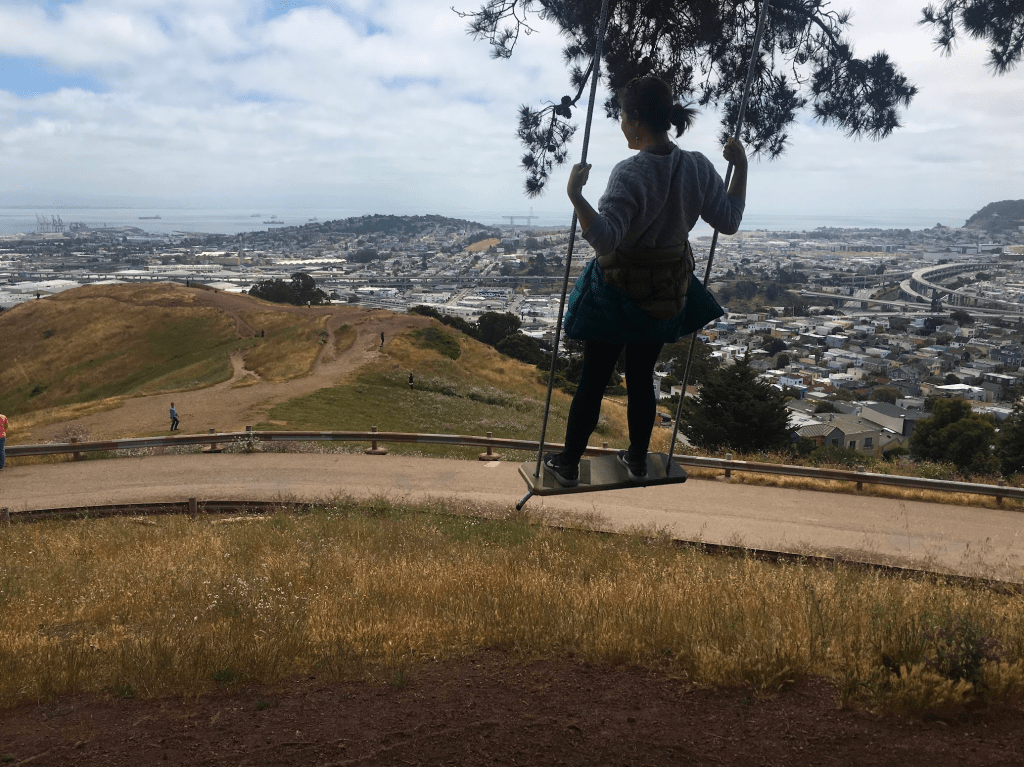
The sapphire blue bay. The pulsing, weaving threads of the cars and trucks on the highways. The cargo ships floating by the port. The skyscrapers of downtown. The dome of San Francisco’s city hall where J and I married. The flat roof of the apartment building where we lived for four years. The lone palm tree marking the apartment where we lived for a fifth. The palm-lined boulevard and former hospital that marked where we lived before that. The bridges connecting land across water.
Across the bay, there was the stone bell tower — the Campanile — marking the city where we’d lived before and where we’d move next.

All land of the Ohlone peoples, as far as the eye can see. All Turtle Island. The land isn’t ours, and never will be. But it’s all home, as much as anywhere else.
“How, in our modern world, can we find our way to understand the earth as a gift again, to make our relations with the world sacred again?” Robin Wall Kimmerer writes in “Braiding Sweetgrass,” “I know we cannot all become hunter-gatherers — the living world could not bear our weight — but even in a market economy, can we behave ‘as if’ the living world were a gift?”
Luke, J and I wrapped our arms around each other. We breathed and took in the view. A red-tailed hawk dived and soared in front of us. I felt J’s ribs expand and contract as he inhaled and exhaled. Luke’s eyes glistened. Were those tears in his eyes? I had a lump in my throat. Together, we experienced awe.
“Blessed are we,” Luke often says. That day, we didn’t say it aloud, but felt it.
* * *

We hurry up and wait, as J says As we prepare to move, I wake earlier than usual: 5:45, 6, 6:30 a.m.
From the balcony, my cat and I watch the sky steep from pink to orange over Bernal. I watch the neighbors take their dogs outside for their morning business, and start pots of coffee in their kitchens. A Recology garbage truck trundles past.
The J streetcar whines on its tracks on Church Street. It rings its bell, heralding its forward motion. I’ve lived in the Bay Area for more than a decade, and I still have no idea where the Muni and BART cars go once they reach the end of the line. Do they reverse? Turn around and scoot over to another track? I could easily look it up, but after all this time, I appreciate the mystery.
Steam curls from my hot coffee in a mug that says “PARIS,” a gift from my grad school roommate. “This is your mug,” she’d told me as we moved out of our Palo Alto apartment nearly eight years ago, back when I dreamed of France.
It turns out that J and I didn’t move to Paris, didn’t pursue France 2020. The only certainty about dreams is that they can change, as easily transformed as a wisp of cloud.
Now, our sights are set on a new plan: Berkeley 2022. There, we’ll raise a family.
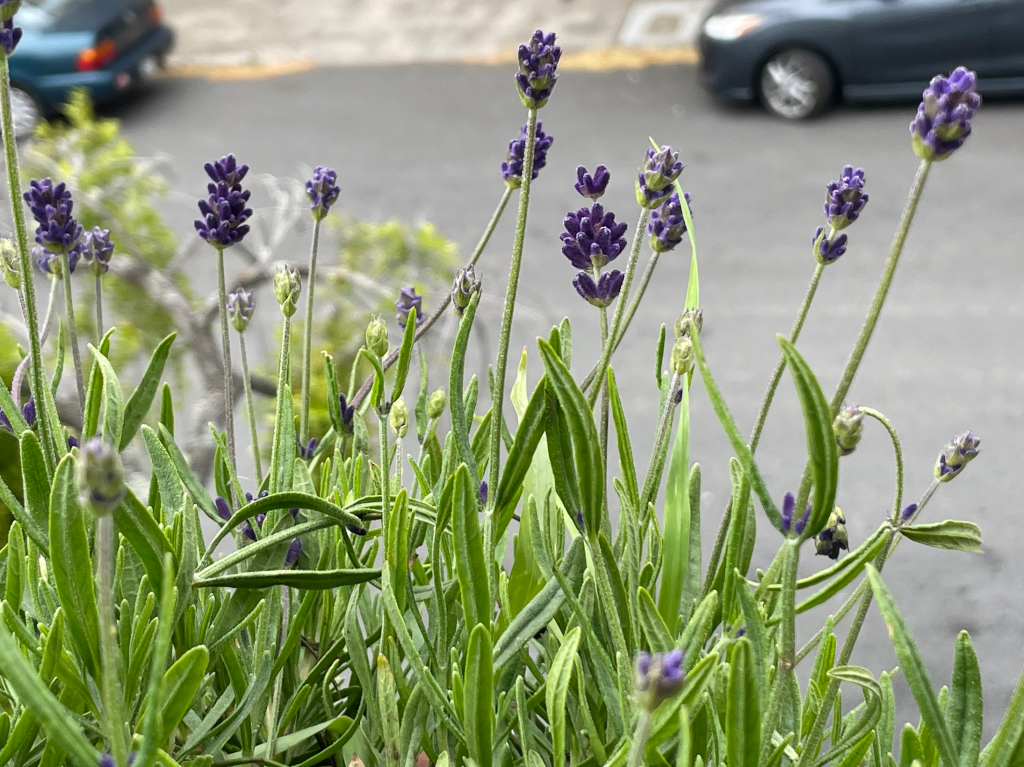
Missing dirt and greenery, we had planted a container garden on our San Francisco apartment’s three-by-seven balcony. J’s limes, once only zesty pith, yielded juicy fruit. We had Goliath tomatoes, once green nubs, that became scarlet, sweet, and savory. A leafy Serrano pepper plant had actual peppers with an energetic bite. We had bushy herbs that became jars of tea and warmed hands and friendships after we decided to plant them.

White lime and star jasmine flowers perfumed the air and drew birds and bumble bees. Green hummingbirds, brown and white song sparrows, yellow and rosy finches, black crows and multi-hued, iridescent pigeons alighted on our balcony and on the telephone wires criss-crossing the street between our neighbors’ homes.
All the while, Muni and sirens wailed, the birds singing.
San Francisco had been full of life all along.



 Palm Trees and Grapevines
Leave a comment