By Sara Hayden
In the middle of the night, my nose bleeds. I suspect it’s from all the ash.
I’d spent a warm fall afternoon at Pie Ranch in Pescadero, on unceded lands of the Quiroste Tribe of the Awasawas Nation. Between August and September of 2020, the CZU Lightning Complex wildfires burned more than 86,500 acres here, across San Mateo and Santa Clara counties, including the Popeloutchom homeland. Now, people throughout the region are seeking regeneration. Much of today’s work is about undoing the harm that’s been done, following first contact with colonizers.
“We’ve been here 16, 17 years — just a tiny fraction of time compared to the thousands of years of the Quiroste tribe that’s connected to these lands,” Pie Ranch co-founder Jered Lawson said. “Clearly, that knowledge has been lost in European management.”
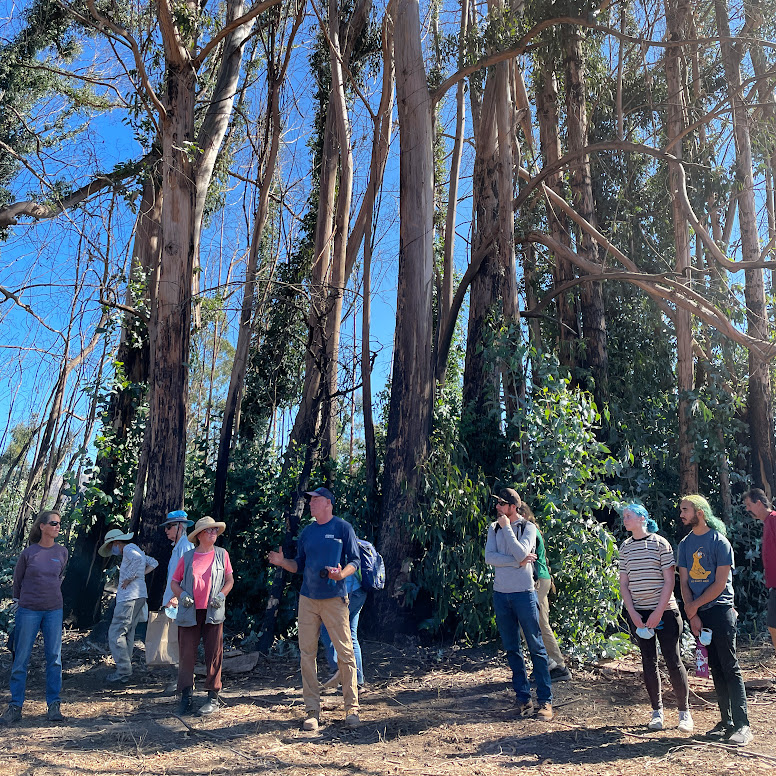
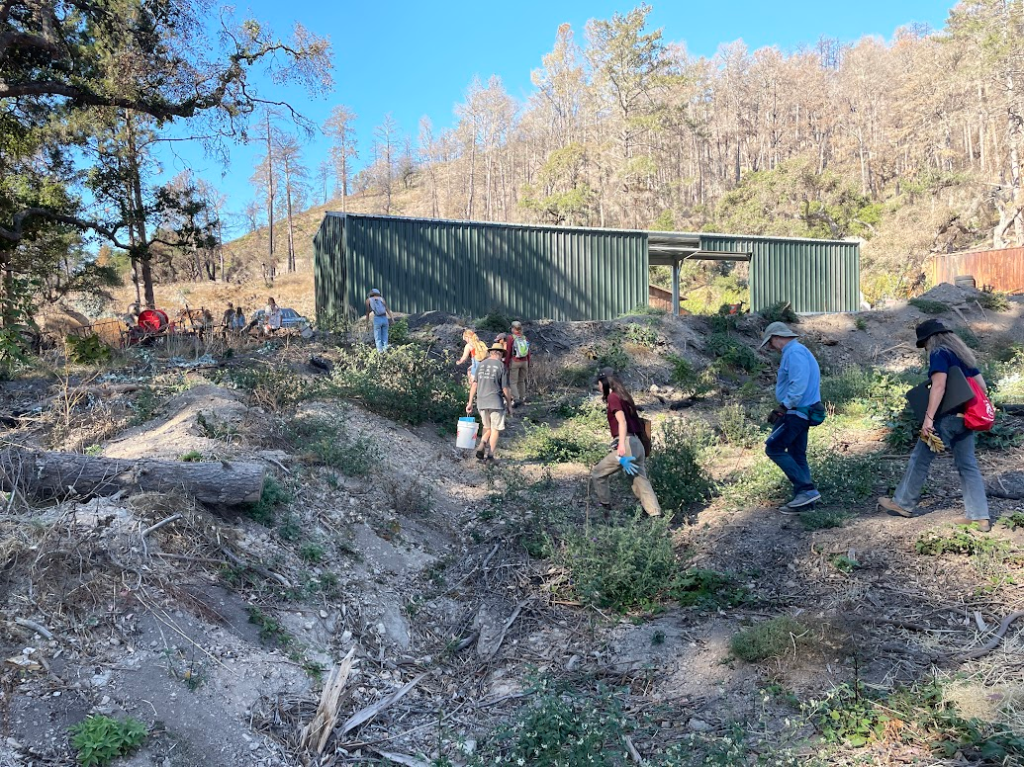
This is what a group of volunteers came to grapple with for the farm’s “Euc-A-Thon,” a walk-a-thon-style fundraiser focused on pulling up eucalyptus saplings. One goal was to help remove invasive, flammable trees that propagated in the wake of the fires.
Another goal was to raise recovery funds. They were to be split equally among the Amah Mutsun Tribal Land Trust, which assumes a stewardship role in the territory for descendants of the Ohlone peoples; Pie Ranch, a Coastside farm with a focus on regeneration and food system education; and the San Mateo County Resource Conservation District, a government agency.
For all, there was yet another goal: Healing.
“Our aspirations are to do that healing together,” Lawson told volunteers. “This day is one example of working together to make this happen.”
* * *
Preparing for the afternoon’s work, people stood in a circle next to the Native Garden. Yarkas, coast tarweed, slept dormant. Presenting glossy green leaves and red rose hips was mamawkwa, California wild rose. All around the farm and beyond, there were trees — some only stumps, others dozens of feet high, some brand new. Many bore the scars of the fire. Many were eucalyptus.

Nathan, a Native Steward, started by giving thanks to the Creator, for the day, for the opportunity to strive for dreams. He softly traced a smoking bundle of dried plants around him, and invited anyone who’d like to to purify themselves.
Next, volunteers collected gloves, water bottles and pecan pie, and then ventured out to different parts of the farm.
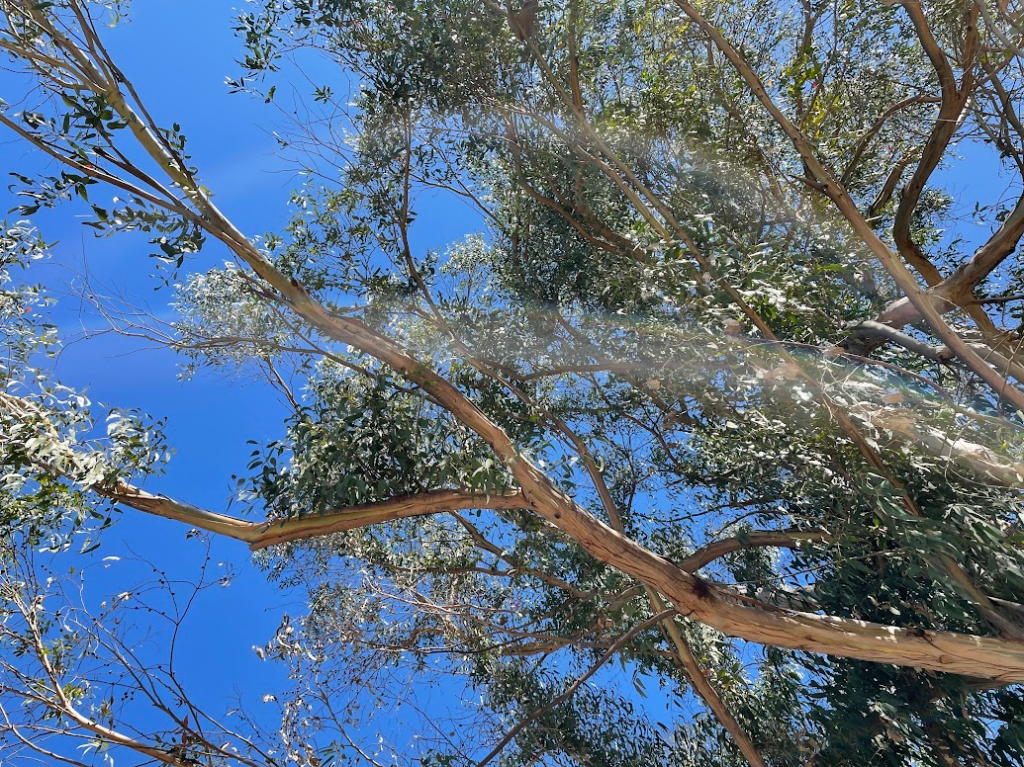
From a distance, silhouettes of trees stood out like burnt matchsticks on the golden hillsides. Close up, verdant growth surrounded them — both beautiful and dangerous: Blue gum eucalyptus can be highly flammable.
Colonists brought the tree to the area at least as far back as the late 1800s. In the years that followed, eucalyptus crowded out native plants. It contributed to drought by using water, and added to fire fuel loads with due to high oil content.
“When it comes to eucalyptus, these were trees that were planted as windbreaks that would serve the agriculture enterprise in a way that would be useful. It turns out they were wrong,” Lawson said in an interview. “I think that’s ecology 101 we’re waking up to.”
* * *
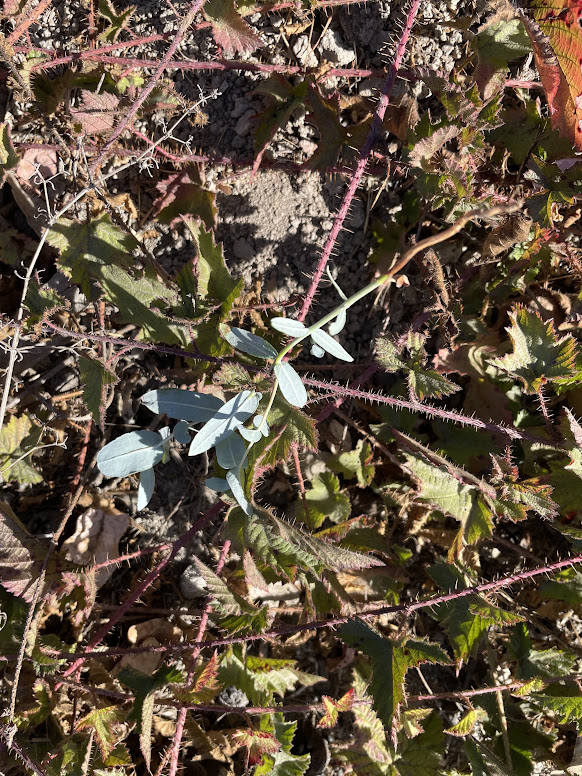
Pie Ranch gets its name in part from its pie slice shape. Situated at the “Lower Slice,” we crouched over blackberry brambles and maneuvered around poison oak. Under all the brush, I was struck by just how many eucalyptus saplings there were.

No matter how many we pulled, there were more. Big stocks piled up. Slender sprouts bearing just a leaf or two peered through the piles that I’d nearly missed. If we didn’t pull them, would they become full-fledged trees?
I looked up across the landscape, and saw eucalyptus giants, saplings sprouting out of them too.
It’s all part of a cycle: “The fires can help with opening up their seeds, getting their seeds to germinate,” Lawson said. “Now you have this flush of saplings that are coming up.”
I was surprised by how easy it was to pull up the saplings, their shallow roots slipping out of the ash and soil more easily than a dandelion’s. It’s as though a volunteer named Kelly was reading my mind when she said to her teenage daughter, “These are easier to take out than the weeds at home.”
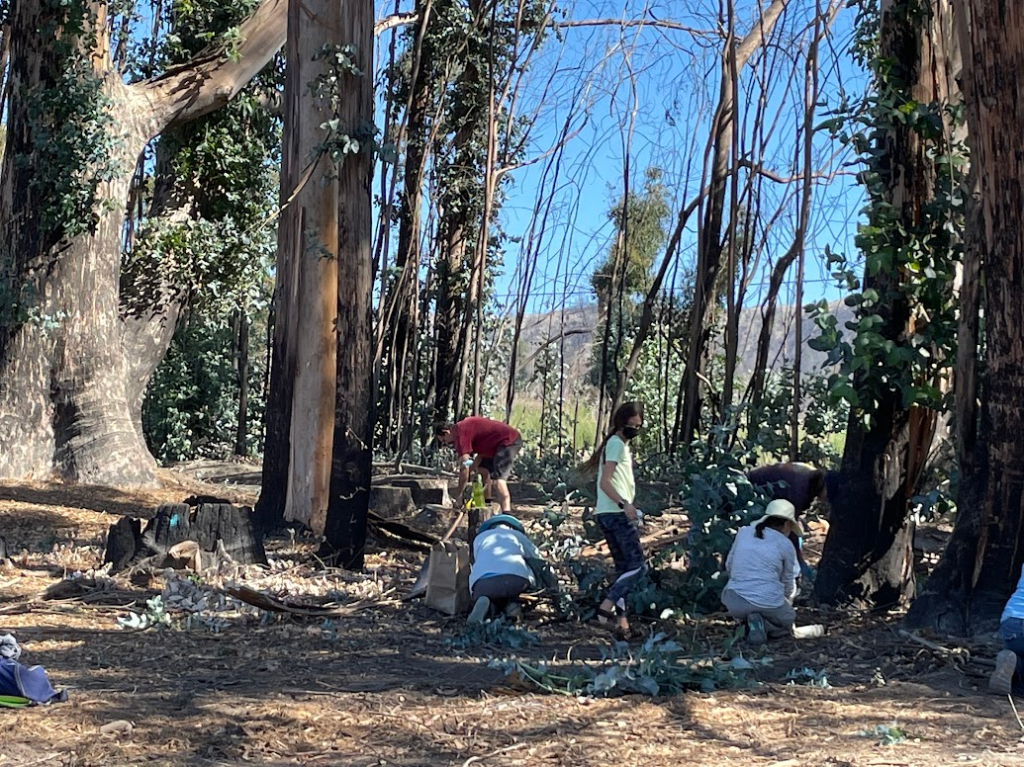
A “mountain kid” from north of Santa Cruz, Kelly said she’d recently been studying local history, filling in gaps that were missing in her formal education. Learning about the land and its people is a part of that.
“I always questioned things—some things just didn’t make sense,” Kelly told me, like how the stories of people who lived here for generations were absent from her classrooms. “It’s time for us to show up,” she said.
* * *
In my own classrooms, I didn’t learn about the history underpinning contemporary fire policies, and how they conflicted with what had been practiced by the people that lived here before for generations.
It turns out that dominant land management practices from the last century resulted in a build-up of biomass like invasive eucalyptus that became fuel for fire.
Those historic policies were spurred by the “Big Blowup” of 1910: Over the course of just two days, fires burnt millions of acres and killed dozens of people across Montana, Idaho and Washington.
In response, U.S. Forest Service leaders and policymakers sought solutions that aimed to minimize the financial cost of fire management and damage — and aimed to protect the timber industry.
The policy they pursued? Total fire suppression. It bucked the trend of light burning, which had been favored by indigenous land stewards, farmers, ranchers and timbermen who had seen fire as a means to improve land health.
According to the Natural Hazards Observer, by 1935, the aggressive “10 a.m. policy” had been adopted, outlining a goal to suppress fire as quickly as possible — ideally within a single work day: “…Failing in this effort, the attack each succeeding day will be planned and executed with the aim, without reservation, of obtaining control before ten o’clock the next morning.”
In 1944, the Forest Service launched a public education campaign advocating for fire prevention. Its poster cub was Smokey Bear, which remains a household name today.
Total fire suppression has since proven insufficient, and policymakers are adapting practices.
In 2019, the Department of Interior issued Order 3372, which mandated “active management” to reduce wildfire risks. That includes seeding non-invasive plants, thinning and removing vegetation, using biological and chemical treatments and controlled burns. The order outlines that it’s a shared responsibility that involves not only the department, but also “Agencies, States, Territories, Tribes, localities and stakeholder groups.”
* * *
Within classroom walls and outdoors, there’s much to learn from the past, assessing the impact of historic government policies, and respecting traditional stewardship knowledge.
At Pie Ranch, San Mateo County Resource Conservation District executive director Kellyx Nelson addressed Euc-A-Thon volunteers standing in the shade of towering eucalyptus. “You know that joke where government is here to help? We actually are,” Nelson said. “We’re a local government agency that exists to help people help the land.”

What that help looks like evolves as knowledge about ecology and relationships with land change. “We’ve been around since the ’30s. I think we planted (eucalyptus) too, so I think it was a little bit of reparations going on here,” Nelson said. “A lot of what we’re doing now is undoing what we did 80 years ago.”
Eucalyptus’s impact on the environment reminded me of other plants I’d once taken for granted as part of the natural northern California landscape that are actually invasive. Pampas grass introduced by nursery operators in the mid-1800s can physically harm animals and decrease biodiversity. Ice plant introduced in the 1900s to prevent erosion on rail tracks and roadways choked out native plants and altered soil composition. English ivy, sold for decoration, has outcompeted some understory vegetation species and killed overstory trees, and it’s toxic to humans and animals.
U.S. government agencies and businesses have propelled use of some of these plant species that have turned out to do more harm than good. Land stewards are revisiting these now, and seeking to restore native plants. Instead of eucalyptus, there could be other plants that help shield farmland from wind and provide pollination — we could use native trees, shrubs and grasses that benefit animals, people and the environment overall.
“There’s a new synergy of weaving together that practice with what is culturally relevant for indigenous communities that have been in relationship to these plants thousands of years before we were here,” Lawson said.
I picture the Native Garden at Pie Ranch. There are thimbleberries and beach strawberries, blue wild rye and arroyo willows. There are plants for food, basketry, medicine and much else, as well as habitat for animals.
Stewards are restoring what was, and providing a snapshot of what could be. With the stewardship of the Amah Mutsun Tribal Land Trust and their partners, what will the landscape look like in future? What can come to fruition?
* * *
We cut across to the far side of the farm and continue pulling saplings. As we crossed a dry creek bed, I was humbled by the earth’s dryness: We faced drought conditions across the state. With exceptional drought conditions, fields had been left to fallow. Vegetable and honey yields were low, as was survival of native plants and animals.

As of 2022, we’re in the midst of the second driest year on record in the last 128 years in San Mateo County, according to government drought resources. On the Peninsula, extreme drought stunted local crop germination and pasturelands. It changed wildlife patterns and accelerated when fruit trees bloom. It caused ponds and creeks and reservoirs to hover low. It threatened animals, and impeded agriculturalists’ ability to feed people too.
At this level of drought, ever present is the danger of fire: Fire season is now considered year-round.
As I walked on the road through Pie Ranch, ashen dust exploded like cloudbursts under footfall. At the top of a hill, I accidentally slipped. I instinctively reached for whatever I could, and grabbed the charred trunk of a tree. The bark disintegrated on contact, flickering into the air like black glitter.

We passed trunks as wide as cars from trees that were felled from the fire. There was a green pond with a rowboat resting on the bank, near an irrigation system that had melted. Marked out by orange tape and planks of wood, new foundations had been laid to replace housing that was destroyed by fire.
When we were walking, I met Cruz, who had come to Pie Ranch with his son. “I wonder what we’re doing tomorrow. I hope it’s another adventure like this,” he said, referring to his son’s work sharing knowledge at the Native Garden. From Madera, father and son have traveled throughout the territory, healing and restoring connection with land and culture.
Along the way, in addition to pulling eucalyptus saplings, they’ve planted plum trees. They’ve gardened. They’ve climbed the hillsides to see the views from the top. “People tell me Hawaii, China’s across the way,” Cruz said. “All I see is the ocean.”
I looked down the hillside and out to the coast. The Pacific Ocean looked endless. Unfathomably vast, its silver shimmer pooled into eternity.
“It’s arrogant for humans to think that we could destroy the planet. We might not be around, but the planet will be,” a volunteer named Everett told me. I believe it to be true when I take in the sweeping views around.
* * *
Said in a different time, a different place, a different context, I wondered if this resonated: “My elders said we have to go back,” Amah Mutsun Tribal Band Chairman Valentin Lopez told me in a 2018 interview. “The Creator never rescinded the obligation to Mother Earth and all living things.”
There’s a convergence of events that are making conditions increasingly volatile, contributing to catastrophic wildfires and floods, Lawson said. There’s drought, antiquated infrastructure, extreme weather and heat — all intensified by human activity.

Humans are responsible for this destruction, certainly. On the flipside of that, humans are responsible for healing.
“This day is one example of working together to make this happen,” Lawson said at the start of the Euc-A-Thon.
Maybe this healing starts with one day at a time, or even just one sapling at a time.
—
Pie Ranch
pieranch.org
2080 Cabrillo Hwy.
Pescadero, CA 94060


 Palm Trees and Grapevines
Leave a comment